Did you know that over 90% of traders fail prop evaluation programs due to preventable mistakes?
Unfortunately, most traders approach these assessments without a clear strategy, leading to frustration and wasted fees.
Proprietary trading offers a unique opportunity to access significant capital without risking your own money, but passing these trading challenges requires more than just profitable trades.
In fact, even consistently profitable traders can fail evaluations by overlooking specific rules or trading restrictions.
The path to funded accounts involves understanding not just the markets, but also the specific requirements of each firm’s assessment process.
This step-by-step guide will walk you through everything you need to know about trading evaluation methods, common pitfalls to avoid, and proven strategies that can significantly increase your chances of success.
Whether you’re attempting your first challenge or looking to improve after previous attempts, these insights will help transform your approach to securing that coveted funded trader status.

Understand the Types of Prop Evaluation Programs
Understanding the different evaluation types is essential before starting your prop trading journey.
This will help you select the program that aligns with your trading style and experience. Different prop firms offer various paths to funding, each with unique requirements and advantages.
One-Step vs Two-Step vs Three-Step
Proprietary trading firms have developed multiple evaluation frameworks to assess a trader’s capabilities before providing capital. These frameworks differ primarily in complexity and the number of stages involved.
One-Step Evaluation Programs offer the most straightforward path to funded accounts.
Unlike multi-stage evaluations, a one-step challenge consists of a single phase where traders must demonstrate their skills and readiness to manage capital.
This streamlined approach focuses exclusively on your ability to meet profit targets while adhering to risk management rules.
After successfully completing this single evaluation, traders progress directly to funded account status, where they can earn up to 90% of generated profits.
Although simpler in structure, one-step evaluations often present unique challenges:
- They may be harder to pass due to trailing drawdown requirements or lower profit-to-drawdown ratios
- The evaluation period varies between firms, yet is generally designed to be efficient
- Some programs offer unlimited time frames, allowing traders to complete the challenge at their own pace
Two-Step Evaluation Programs represent the industry standard and involve a more comprehensive assessment process.
During the first phase, traders must reach specific profit targets without exceeding maximum daily loss or maximum loss limits.
The second phase then focuses on demonstrating consistent performance while maintaining effective risk management practices.
This approach provides a balanced assessment of both profit-generating capabilities and risk control.
Three-Step Evaluation Programs are relatively rare (we recommend FTMO and FXIFY) and feature the most rigorous assessment structure.
These programs add another layer of evaluation, requiring traders to pass through three sequential profit targets and drawdown limits before accessing funded capital.
Each phase builds upon the previous one, creating a thorough vetting process that typically identifies the most disciplined and consistent traders.
Direct Funding and Assessment-Based Models
Beyond the number of evaluation steps, prop firms broadly fall into two distinct operational models:
Assessment-based models require traders to prove their skills by meeting specific profit targets under strict rules. This process typically involves one or more phases that test consistency, risk management, and profitability.
These traditional evaluation programs generally feature:
- Demo account testing followed by live trading requirements
- Profit targets ranging from 6-12% and trading periods of 5-30 days
- Lower upfront costs compared to direct funding options
- Higher profit splits after successful completion
- Structured development path is ideal for beginner and intermediate traders
Direct Funding Models have emerged as an alternative approach that provides immediate access to trading capital.
These programs allow traders to bypass the evaluation process entirely, offering several distinct advantages:
- Time savings by eliminating weeks or months spent on qualification tasks
- Immediate profit potential from the very first trade
- Reduced pressure without strict evaluation criteria to constantly monitor
- Fewer trading restrictions and simplified rules
Nevertheless, direct funding typically comes with tradeoffs.
Many firms offering instant access provide lower profit splits (between 20-50%) compared to evaluation-based models.
Additionally, these programs generally require higher upfront fees to compensate for the increased risk the prop firm assumes.
When selecting between these models, consider your experience level, risk tolerance, and timeline for generating returns.
Assessment-based programs better serve those looking to develop skills and earn higher long-term profit splits, while direct funding appeals to experienced traders seeking immediate market access without evaluation hurdles.
Know the Rules Before You Start
Success in prop evaluation programs hinges on mastering each firm’s rules.
Many traders with profitable strategies still fail evaluations simply because they overlook crucial requirements or restrictions.
Understanding these rules thoroughly will save you time, money, and frustration while pursuing funded trading.
Profit Targets and Drawdown Limits
Prop firms establish profit targets as a percentage of your account size, typically 5-10%.
These targets verify your ability to generate consistent returns while managing risk effectively.
For instance, some one-step evaluations require a 10% profit target, while two-step evaluations might require 10% for phase one and 5% for phase two.
Equally important are drawdown limits, which come in two critical forms:
- Daily drawdown limits restrict losses within a single trading session, typically set between 4-5% of account balance
- Maximum drawdown limits cap your total account losses, usually between 5-10%
Furthermore, firms implement either static or trailing drawdowns. Static drawdowns are calculated from your initial balance, while trailing drawdowns adjust upward as your account grows, protecting profits already earned.
Understanding which type applies to your evaluation is essential, as trailing drawdowns become more restrictive as your account balance increases.
Time Limits and Trading Restrictions
Time constraints vary significantly across prop firms. Traditional firms often require meeting profit targets within 20-30 days.
However, more trader-friendly options offer unlimited time frames for completing challenges, allowing you to:
- Trade at your own pace without pressure
- Wait for optimal market conditions
- Focus on quality trades rather than rushing to meet deadlines
Some firms mandate minimum trading days before you can advance, varying from 7 days for smaller accounts to 40 days for larger ones.
This prevents traders from getting lucky with a few high-risk trades and forces the demonstration of consistent performance.
Common trading restrictions include limitations on:
- Expert Advisors (EAs), especially those using hedging, martingale, or grid trading systems
- Position holding periods, though firms like Funding Traders allow overnight and weekend positions
- Trading during high-volatility periods or major news events
Firm-Specific Conditions to Watch For
Beyond standard rules, watch for unique firm requirements that can cause unexpected disqualification:
Position sizing rules often restrict the maximum risk per trade (typically 1-2% of the account) and may include absolute limits on lot sizes based on account funding level.
Some firms implement consistency rules requiring traders to maintain their strategy even after reaching profit targets.
Beware of “hyperactivity” restrictions – some firms limit daily trade counts or server messages (order modifications), with penalties for exceeding 2,000 messages in a single day.
Additionally, check for prohibitions against one-sided betting or account rolling tactics.
Most importantly, carefully review all terms and conditions before purchasing any challenge.
Rules change frequently, and minor violations, even unintentional ones, can result in immediate account termination without refund.
Build a Strategy to Pass the Evaluation
Developing a comprehensive strategy is the foundation for success in prop evaluation programs.
According to industry experts, a well-structured approach dramatically increases your chances of securing funded trading accounts, where most traders fall short.
Create a Trading Plan
A trading plan serves as your personalized roadmap throughout the evaluation process. This detailed document should outline every aspect of your trading approach, from position sizing to specific market conditions you’ll monitor.
Your plan should include:
- Motivation and time commitment – Define why you’re trading and how much time you can realistically dedicate
- Clear financial goals – Set SMART objectives (Specific, Measurable, Attainable, Relevant, Time-bound) for your evaluation
- Risk parameters – Establish your risk-reward ratio (ideally 1:3 or higher) and maximum risk per trade
- Entry and exit criteria – Specify exact conditions for opening and closing positions
- Record-keeping process – Structure how you’ll document and analyze your trades
The trading plan differs from backtesting by describing the entire trading process rather than just statistics.
It helps maintain consistency and discipline through favorable and challenging market conditions.
Choose Your Trading Style
Your trading style should align with your personality, risk tolerance, and the specific requirements of your chosen prop firm. Four primary styles work well for evaluation programs:
Scalping Strategy – Involves quick entries and exits, typically on 1-minute or 5-minute charts. This high-frequency approach can help achieve profit targets quickly, though it requires intense focus and excellent execution.
Trend Following Strategy – Ideal when markets show clear directional movement. First identify trend bias on higher timeframes, then follow the established momentum. Trailing stops can protect floating profits as the trend develops.
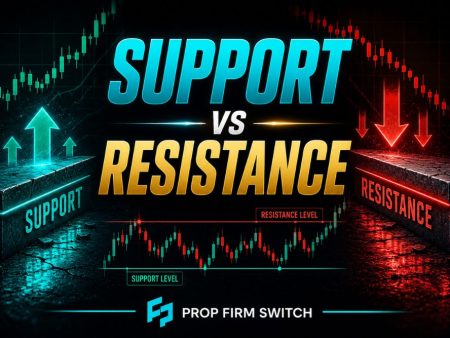
Range Trading Strategy – Effective during consolidation periods when markets move between support and resistance levels. Buy near support and sell near resistance, always using stop-losses as ranges eventually break.
News Trading Strategy – Suitable for traders with strong fundamental analysis skills. Requires monitoring economic calendars and understanding how to interpret data releases. Be aware that spreads typically widen during major announcements.
Backtest and Forward Test Your Strategy
Testing thoroughly validates your strategy before risking real or firm capital. This two-stage process identifies weaknesses and builds confidence in your approach.
Backtesting allows you to evaluate your strategy against historical data. For manual backtesting, create a spreadsheet to document trades while applying your rules to past chart movements. Focus on these key metrics:
- Win rate percentage
- Risk-reward ratio
- Expected return
- Profit factor (ratio of total profits to total losses)
- Maximum drawdown
- Sharpe ratio
Forward testing takes your backtested strategy into real-time market conditions.
This crucial step reveals how your strategy performs with current data and helps you experience the psychological aspects of trading.
For effective forward testing:
- Use a demo account that resembles your intended trading platform
- Familiarize yourself with position sizing tools and platform functions
- Execute trades precisely according to your strategy rules
- Keep a detailed journal with screenshots of trade setups
- Compare results with your backtesting data to identify discrepancies
Forward testing is time-consuming but essential; you’re literally testing in real-time, consequently requiring patience for reliable results.
This process bridges the gap between theory and execution, providing invaluable insights into how your strategy will perform under actual evaluation conditions.
Avoid Common Mistakes That Lead to Failure
Many traders fail prop evaluations even with a perfect strategy due to avoidable mistakes.
Understanding these common pitfalls can significantly increase your chances of passing proprietary trading assessments.
Breaking Rules Unknowingly
Misunderstanding or overlooking firm-specific rules accounts for numerous evaluation failures.
Many traders inadvertently violate trading restrictions without realizing it.
Specifically, common violations include trading during major news events, exceeding maximum position sizes, holding positions during prohibited times, and not setting proper stop losses.
Moreover, some firms impose strict limitations on trading hours, allowing trades only during peak sessions like London or New York.
Others implement consistency rules requiring traders to maintain their approach even after reaching profit targets.
Before starting, thoroughly review all terms as rules change frequently, and even minor unintentional violations can result in immediate account termination.
Overtrading and Revenge Trading
Revenge trading stems from emotional reactions to losses, particularly frustration and anger.
Instead of making calculated decisions, traders driven by revenge focus on immediate recovery, often neglecting their trading plan.
This behavior creates a dangerous cycle where one small loss drives increasingly risky decisions.
To prevent overtrading:
- Set a daily trade limit to avoid excessive market exposure
- Step away after losses to regain emotional balance
- Follow your pre-defined trading plan strictly
- Consider joining trading communities for accountability
Indeed, emotional control might be the single biggest factor differentiating successful prop traders from those who never secure funding.
Ignoring Risk Management
Despite its fundamental importance, poor risk management remains among the most common errors in proprietary trading.
Above all, successful traders typically risk no more than 0.5-1% per trade, even when their personal trading style might suggest larger positions.
Daily drawdown awareness is crucial – many traders overlook their daily loss limits, jeopardizing their chance to get funded.
Implement the 2% rule: if you lose 2% of your account balance in a day, stop trading to prevent emotional decisions and “revenge” trading [22].
Tips and Strategies to Maximize Your Success
Mastering specific tactical elements can improve your chances of passing prop evaluation programs.
After developing your strategy and avoiding common pitfalls, implementing these proven techniques will significantly increase your likelihood of securing funded trading.
Use Proper Position Sizing
Position sizing represents the cornerstone of successful evaluation trading
Initially, implement the fixed fractional method by risking only 0.5-1% of your account equity per trade.
For a $100,000 funded account, this translates to a maximum risk of $1,000 per position.
Calculating optimal position size requires four key factors:
- Account balance percentage (1-2% maximum risk)
- Stop loss distance in points
- Specific instrument volatility
- Current drawdown level
Notably, during drawdown periods, reduce your position size by half until recovery begins.
This preservation technique maintains capital while preventing emotional deterioration during challenging market phases.
Trade During High Liquidity Hours
Timing your trades around peak market activity periods substantially improves execution quality. Focus primarily on the London and New York sessions when volatility and liquidity reach optimal levels.
Create a structured schedule with:
- 30 minutes of pre-market analysis
- 4-6 hours of active trading during prime sessions
- 30 minutes of post-trading review
This disciplined approach prevents trading during thin markets where slippage can undermine otherwise sound strategies.
Furthermore, traders who align their activity with these high-opportunity windows demonstrate greater consistency in evaluation performance.
Stay Emotionally Disciplined
Emotional control often determines success or failure in prop evaluations.
In light of this reality, develop specific protocols for maintaining psychological balance throughout the trading process.
Track your emotional triggers with measurable recovery times – for instance, after three consecutive losses, take a mandatory 30-minute break.
Meanwhile, implement techniques like setting fixed daily loss limits ($1,500 for a $100,000 account) to prevent revenge trading after setbacks.
As shown above, successful evaluation traders maintain emotional stability through practical methods rather than willpower alone.
On balance, those who document their psychological states alongside technical analysis demonstrate significantly greater evaluation success rates.
Your Next Steps
Passing prop evaluation programs ultimately comes down to thorough preparation and disciplined execution.
Throughout this guide, we’ve explored the critical elements that separate successful traders from those who repeatedly fail these assessments.
Above all, understanding the specific requirements of your chosen program – whether it’s a one-step, two-step, or direct funding model – creates the foundation for your approach.
Additionally, mastering each firm’s unique rules regarding profit targets, drawdown limits, and trading restrictions helps prevent unnecessary disqualification.
Most importantly, your trading strategy must align with both your personal style and the evaluation parameters.
A well-documented trading plan, combined with proper position sizing and risk management, significantly increases your chances of success.
Meanwhile, emotional discipline remains the invisible factor that often determines whether you’ll secure funding.
Although the path to funded trading presents challenges, the structured approach outlined in this guide provides a clear roadmap to overcome them.
Rather than viewing prop evaluations as insurmountable obstacles, see them as opportunities to refine your trading process and demonstrate your capabilities.
The difference between funded traders and those who continually fall short often lies not in their market knowledge but in their preparation, discipline, and attention to detail.
Therefore, take time to thoroughly research prop firms, test your strategies, and develop emotional resilience before attempting your next evaluation.
Subsequently, you’ll find yourself much better positioned to join the relatively small percentage of traders who successfully secure proprietary capital.